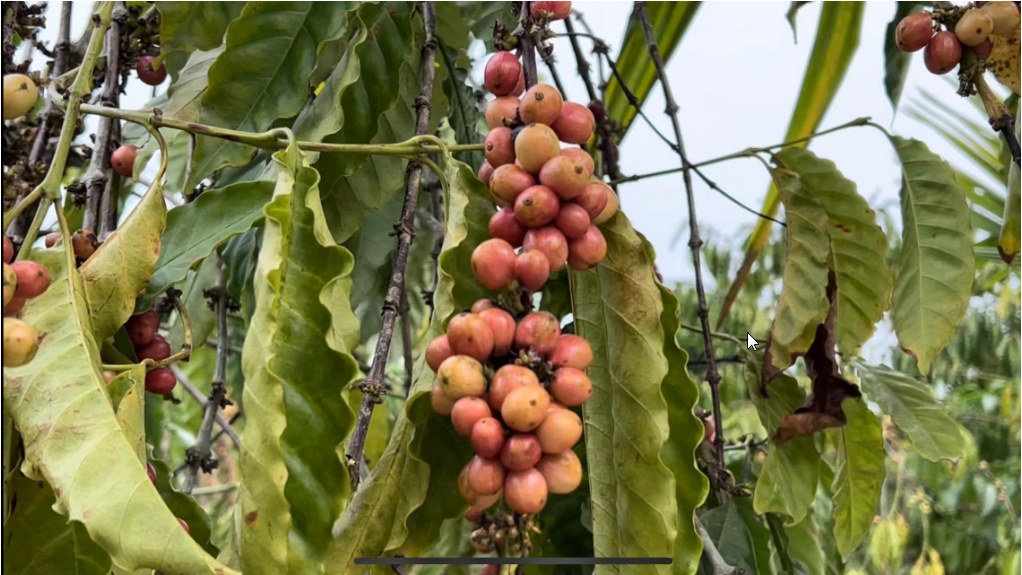
 ▲Hainan's indigenous coffee breed, "Dafen-1" ripes at the middle of south China's island province, April 10, 2023./CGTN
On April 11, farmers at the Limu Mountain in south China's island province of Hainan were bringing in their freshly picked coffee fruits to a coffee plant located in the middle of the island. It is the final stage of harvesting coffee fruits in Hainan.
Lying on the "coffee bean belt" with natural volcanic soil, Hainan is ideal for coffee plantation, but does not have much land.
Due to the fragmentation of land, Hainan's coffee plantation scale is "difficult to match Yunnan or other regions around the world, and thus cannot meet the demand of large-scale coffee production," said Zhao Jinlong, the general manager of CP Group's Hainan Xinglong Coffee Industry Development, in an interview with CGTN.
Historical coffee plantation region
While Hainan is known to most people as a tropical paradise for tourism, it is in fact, home to China's earliest coffee plantation outside Yunnan Province.
Hainan has a long history of coffee tree cultivation. The first coffee seed was brought back by overseas Chinese returning from Southeast Asia back in the 1890s, according to Hainan Daily, with only 12 trees surviving.
Later on, overseas Chinese returning from the Southeast Asia continued to scale up the plantation and expand the coffee culture throughout the island. The first coffee plant, Sun River Coffee, was established in 1953 in Xinglong region on the south of the island. And local farmers began to cultivate their own breed, "Dafeng-1," since 1956 in the middle of the island, according to the 'Agricultural Reclamation Records of Hainan Province.'
Even then Chinese premier Zhou Enlai praised Xinglong coffee as the best he'd ever tried after visiting Xinglong tasting the local brew in 1960.
Dilemma of Hainan coffee
Different from the other major small-size coffee bean type - Arabica - that's been widely grown along the "coffee bean belt," the type that's indigenous in Hainan is a medium-size fruit, Robusta.
As the demand and consumption for coffee production rose over the past decades, the global Robusta bean took up to 45 percent of the world coffee production.
However, local farmers in Hainan didn't have much incentive to grow coffee trees due to the limitation of land, and yield variation. Yet still, local crop scientists worked in the field for years to cultivate a type that could adapt to Hainan's condition.
"We've been planting coffee trees in Hainan for 67 years," said Li Yu, Party secretary and chairman of Hainan State Farms Tropical Products Industry Group (Haiken Group).
According to Li, his coffee tree breed "Dafeng-1" has achieved an average yield of 2,000 Jin (one Jin is the equivalent of half a kilogram) per mu, or about 15 tonnes per hectare. They applied years of grafting and special protection of the scions to ensure a high yield of fruits that are not heavy enough to break the branches.
Haiken Group currently owns 4,461 mu (297.4 hectare) of this type of coffee tree plantation in the Limu mountain area, and the plantation also promoted nearby farmers to switch around 1,000 mu to coffee plantations, Li said.
But in order to sell Hainan's Robusta coffee bean to the world, that is not far enough.
Free Trade Port as a solution: 'Global purchase and sales'
China announced a plan to turn Hainan into a free trade pilot zone and a free trade port in April, 2018. Over the past five years, preferential policies such as zero tariffs and low tax rates have prompted more enterprises to expand their business here.
As the area celebrates the fifth anniversary of the establishment of the free trade port, many international brands came to visit the ongoing China International Consumer Products Expo (CICPE) and decided to expand their businesses in China from there.
"We want to see whether it is possible to expand our presence in China in coffee with the cooperation of Hainan companies," Robin Setyono, CEO of Indonesian coffee behemoth Kapal Api Global, talked to CGTN when he was visiting the Haiken Group.
"We believe that the Chinese market has a lot of potential and Hainan, with its coffee culture, is a very good place to start expanding in China," he said.
CP Group, a multinational corporation with a regional office in Beijing, has eyed Hainan's FTP policies for coffee business. It has established a tourism site based on coffee production plant in Xinglong after acquiring the Sun River Coffee plant in 2020, bringing in new momentum for a historically-famous brand.
"We are open to acquire coffee fruits from the surrounding farmers," Zhao said.
With CP Group's international logistics advantage adding on to Hainan's free trade port policies, the company aims to carry out "global purchase and sales" of Hainan coffee, he added.
Apart from coffee bean trading, Hainan is also promoting its domestically developed breed "Dafeng-1" to neighboring countries through the Regional Comprehensive Economic Partnership (RCEP).
"In this way, we can utilize their lower-priced land resources to better explore the planting value of our coffee," Li added. (End)
By/Zhao Chenchen