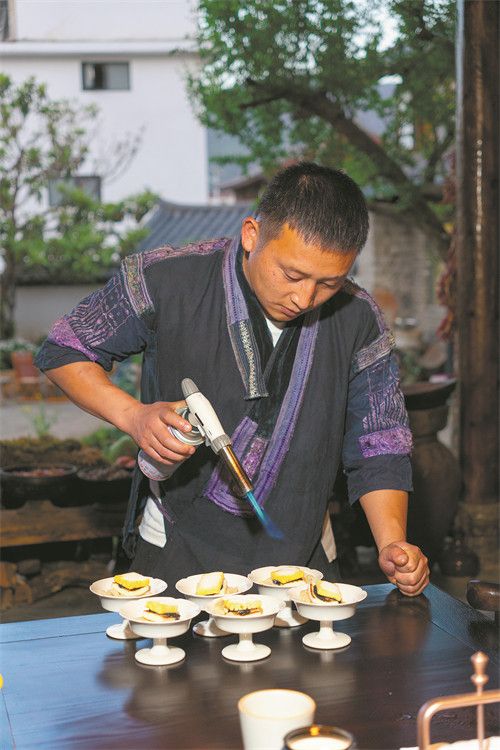
 ▲Wu Tao makes a dish using local materials at his restaurant in Lijiang, Yunnan province. (China Daily)
Before heading to Lijiang in Yunnan province, I had long admired this little city nestled at the foot of snowcapped mountains. Photos and videos of its beautiful scenery left me in awe.
After a four-hour flight from Beijing to Lijiang, I finally stood in the city and, with a simple upward glance, caught a breathtaking view of snowy peaks against the contrast of blue sky and white clouds. They seemed so close as if they were just at the end of the street. At that moment, the true allure of Lijiang unfolded before me.
Early the next morning, I met up with He Zhao, a documentary filmmaker, at Zhongyi Market, which sells a treasure trove of local ingredients, fresh fruits and traditional copperware.
As we wandered through the stalls, Naxi ethnic women in traditional attire strolled along with baskets slung over their backs. The filmmaker suggested I try carrying a similar small bamboo basket.
"It's so convenient," he says. "You can just toss your purchases into the basket as you go."
The most intriguing thing in the market was the variety of wild vegetables — even a seasoned botanist might struggle to name them all. Even He, a Lijiang native, can't identify some of them.
"Many of the vegetables have medicinal properties and are good for your health," he assures me, adding that his family often cooks them at home.
As a photographer and director, He has spent years capturing the beauty and charm of this city and its people through his lens. I decided to follow him on this trip to meet some of Lijiang's fascinating people.
Our first stop was the ancient town where we met He Ronggui, the founder of the Caravan Museum. Like He Zhao, he is also of Naxi descent, and "He" is a prominent surname among the Naxi people.
He Ronggui, 53, and his father were both members of a caravan, spending their youth transporting tea along the Ancient Tea Horse Road in Yunnan. His museum displays a range of items related to the caravan's tea journey.
Due to the long and arduous journeys, caravan members would spend six months to several years on the road. He jokingly says that they were the ultimate outdoor adventurers. They had to master many outdoor survival skills, such as camp safety in the wild, identifying edible plants, and even evading mountain bandits and thieves.
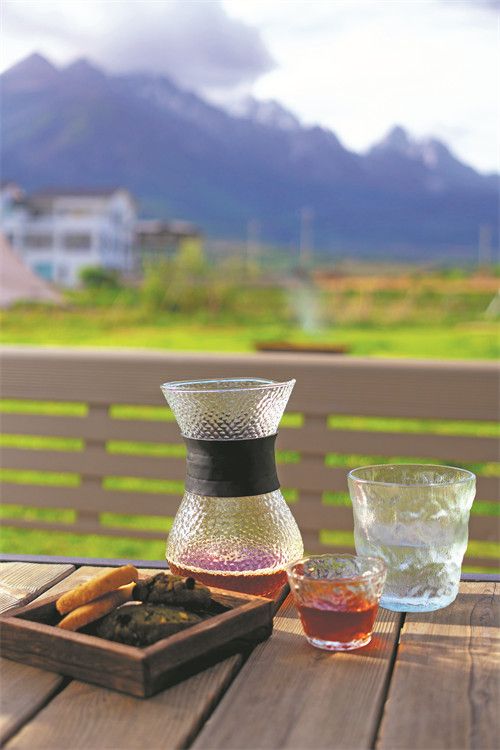 ▲Coffee brewed from locally sourced beans at Xundoushi Coffee Manor. (China Daily)
The large square in front of the museum used to be where caravan teams exchanged goods. For centuries, Lijiang has been an important transit hub on the Ancient Tea Horse Road. Caravans would restock supplies, exchange horses to continue their journey, or trade goods.
"Over 100 caravan teams used to exchange goods here. It was quite a spectacular, bustling scene," he recalls. The hoofprints left on the stone-paved square are a testament to its lively past.
After visiting the private museum, He Zhao took me to his friend's restaurant, which specializes in caravan-style cuisine — a fitting choice. Restaurant owner He Guojun says that the conditions for the caravans were harsh. The most distinctive dish was a pot of soup with cured meat complemented by wild herbs and plants found along the way. His restaurant also offers a variety of similar soups flavored with an assortment of seasonal vegetables and mushrooms.
After lunch, we walked around Lijiang ancient town, a UNESCO World Heritage Site renowned for its well-preserved ancient wooden architecture with tiled roofs and intricate carvings.
Numerous cafes are tucked away behind flower-adorned storefronts. He Zhao says that while the city has no shortage of tour guides, what it really lacks are skilled baristas. Many people enjoy finding a cafe with a scenic view, where they can sip a cup of coffee and gaze at the snowcapped mountains, letting the afternoon pass by.
"Let me show you the life of contemporary Lijiang residents," he says.
We visited Xundoushi Coffee Manor in Baisha ancient town. The cafe is situated on grassland and features a wooden structure that reflects the local architectural style. Guests can rest in outdoor tents on the lawn and enjoy their coffee while taking in the distant Jade Dragon Snow Mountain.
Cafe owner Zhou Li is a professional coffee trainer. All the coffee beans used in the shop are sourced from Yunnan, which accounts for more than 98 percent of China's coffee plantation area and production.
Many customers find the cafe to be a therapeutic experience. Some also visit to learn coffee-making techniques and take the opportunity to relax amid the beautiful scenery.
After watching the sunset over the snowcapped mountains, we headed to a restaurant in the village for dinner.
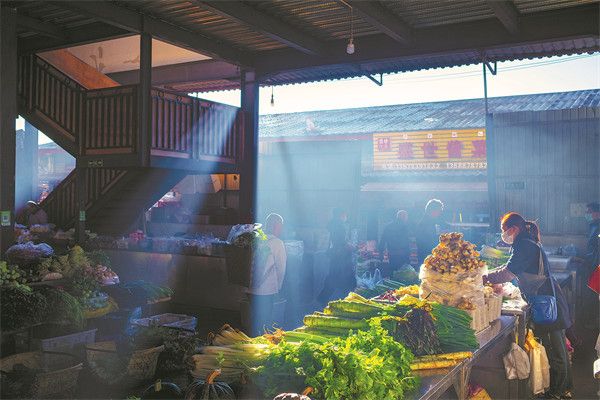 ▲Zhongyi Market in Lijiang, Yunnan province, sells fresh fruits and a variety of wild vegetables. (China Daily)
Wu Tao, a 35-year-old chef from the Miao ethnic group, is one of the founders of the restaurant, with a courtyard where he plants herbs and spices.
For the chef, being in a good mood is essential for cooking, which is why his kitchen faces the mountains, allowing him a glimpse while he prepares dishes.
Wu is good at incorporating local ingredients into his dishes, sourced exclusively from Yunnan. He is working on implementing a plan to source local ingredients from 100 villages across the province.
He also looks forward to taking diners on interesting ingredient-hunting trips to the villages.
The night descended with an uncanny tranquility. As I enjoyed the exquisite local cuisine, the snowcapped mountains emerged in the twilight, their silhouettes etched softly against the darkened sky, like a whispered secret offering unique charm.
From sunrise to sunset and into the dusky night, each moment offers a chance to look up and appreciate the ever-changing forms of the snowcapped mountains. Encounters with intriguing individuals add to the experience — this is the allure of Lijiang, He Zhao says.
The city is also home to many artists and musicians. "We welcome you to return and meet more fascinating souls," he adds. (End)
By/Deng Zhangyu